Sortimento.Online

GTIN/EAN background information

Overview of the GTIN

aka “the little figure with a big impact”

GTIN/EAN – Meaning, Uses, and Benefits for Consumers

The GTIN (Global Trade Item Number) is a globally unique identification number assigned to products – ranging from food to electronics to services. It forms the backbone of modern inventory management systems and enables both businesses and consumers to clearly identify each individual item. While the GTIN promotes efficiency, transparency, and automation in a business context, end consumers in particular benefit from its many advantages on a daily basis – and usually without even realizing it.

GTIN in a business context

For businesses, the GTIN plays a central role in nearly every process along the supply chain. It enables:
  • Efficient Logistics: thanks to unique product identifiers, inventory management, incoming and outgoing goods, orders, and returns are processed more quickly and with fewer errors.
  • Automated Data Exchange: retailers, manufacturers, and platforms can exchange product data in a standardized manner.
  • Global Recognition: a GTIN is valid worldwide – ideal for international markets and e-commerce.
  • Legal certainty and transparency: especially in e-commerce, the GTIN helps prevent product mix-ups and ensures that products are clearly identified.
Yet despite these business advantages, it is often the end consumer who ultimately benefits the most.

Benefits of the GTIN for consumers

The use of the GTIN significantly improves the shopping experience for consumers, as well as product safety and the quality of information. Many benefits occur behind the scenes but have a direct positive impact:
  • Reliable product identification
  • Every GTIN is unique worldwide. This means that what's listed on the packaging is actually what's inside. This makes it much harder to engage in false labeling or mix-ups.
  • Greater comparability
  • Make real price comparisons
  • Compare identical products from different retailers
  • Better detecting counterfeits and plagiarism

Greater transparency and security

The GTIN serves as the foundation for numerous information systems. Consumers benefit from:
  • Recalls and safety alerts: products can be identified and recalled more quickly.
  • Ingredient and origin information: apps for sustainability, nutrition, or allergies use GTINs to display relevant product information.
  • Consumer protection: standardized identification prevents misleading labels.

Simplified use of digital services

From self-checkout at the supermarket to shopping list apps—many technologies work only because of GTIN/EAN. For example, scanning apps instantly provide product reviews, nutritional information, or test reports. Digital household budget planners recognize products by their barcodes. Smart home devices (such as smart refrigerators) also use GTINs to identify items.

The GTIN also plays a significant role in supporting sustainable purchasing decisions. GTIN-based databases enable consumers to access detailed information such as environmental ratings, carbon footprints, details on fair trade or organic certifications, and the like. This makes conscious shopping much easier.

By the way, www.Sortimento.Online digital service can also use GTIN/EAN to offer you more precise, unambiguous, and targeted sourcing options (try it out)
Conclusion

The GTIN is a quiet but indispensable companion to modern consumerism. While GTINs enable companies to operate more efficiently, globally, and in a data-driven manner, end consumers benefit above all from transparency, security, comparability, and reliable information. The GTIN builds trust and enables a seamless, informed, and increasingly digital everyday shopping experience.

Discussion: "Will the economic recovery be driven by GTIN"

The goal here is to investigate and learn more about the reasons why German consumers have so far made so little active use of the GTIN number (formerly known as EAN, or UPC in the U.S.) for any given product. We are interested in opinions, both from a professional perspective on GTIN (PIM / ERP / master data / e-commerce) and from the perspective of the individual consumer.

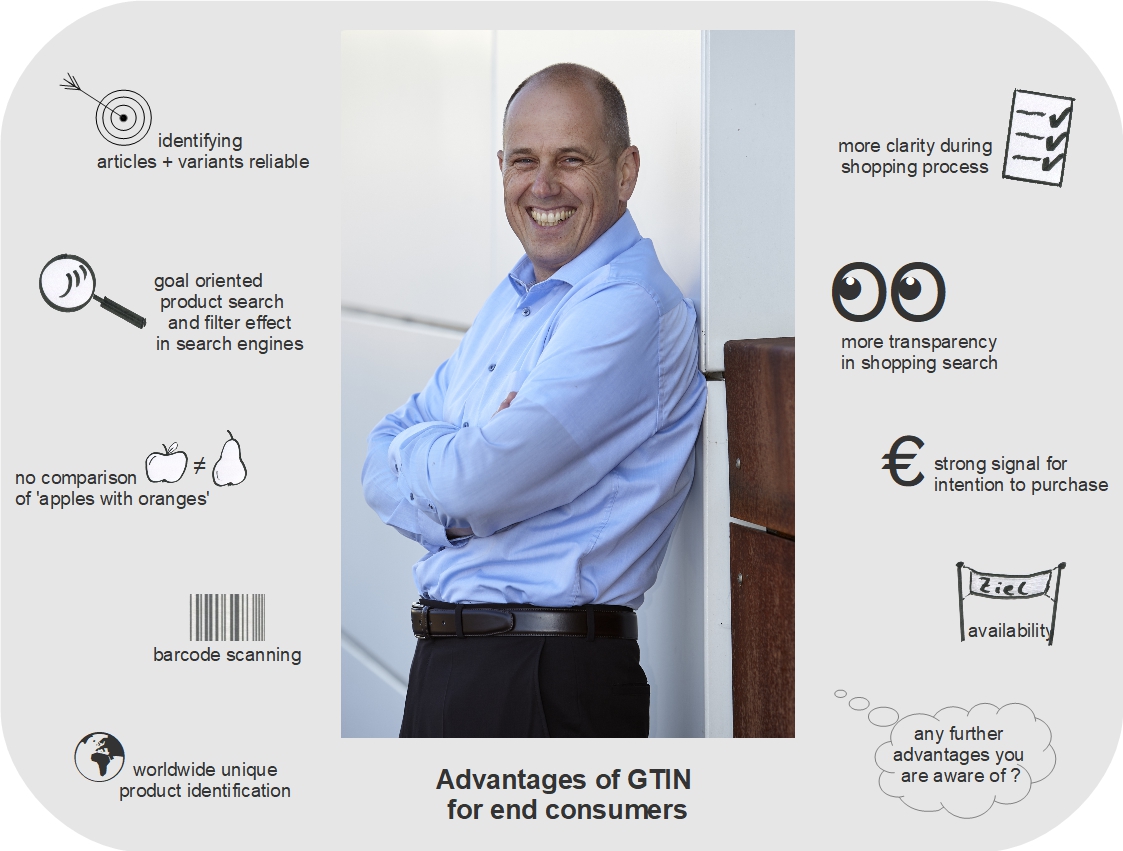
The image lists the key benefits of the GTIN for end consumers using a combination of pictograms and short text snippets. In the center of the image, a man in a blue shirt is leaning against a house wall, smiling cheerfully.
Source: www.Sortimento.Online, 2025
It often seems as though end consumers, largely out of sheer habit, fail to take advantage of the benefits offered by the regular, daily use of GTIN/EAN. Is that really the case? Are you really an oddball if you find a GTIN appealing and actively use it? Is it different in your country ?

Couldn't the GTIN – as the globally unique identifier for an item or item variant – be used to promote economic growth, for example by: In case you would like to learn more or join the discussion, see
here on LinkedIn, pls.

Guest post on: "Will the economic recovery be driven by GTIN"

Mr. D. Walter published an engaging article on the topic of "Will the economic recovery be driven by GTIN". With the author’s kind permission, we are also able to reproduce it here:


In a post, the question was raised as to whether using GTIN (formerly known as EAN) in product searches could lead to an economic upswing.

“Customer satisfaction is at the heart of all business activity,” as P. F. Drucker put it. Against this backdrop, the question regularly arises as to what the value of a product or service is – that is, what benefit it provides to the customer.

"What is a GTIN?" GS1

The GTIN (short for Global Trade Item Number) is the 13-digit number [although there are also 8-digit and 14-digit numbers. Author's note] located below the barcode. The GTIN allows any item, product, or product variant to be uniquely identified worldwide. It serves as an access key to product information stored in databases, such as the product name, weight, package size, or product category.

The GTIN also serves as the basis for the barcode. The barcode makes the GTIN machine-readable, allowing it to be automatically scanned, for example, at a retail checkout or during goods receipt in a warehouse.

What role do GTINs and barcodes play in retail and online commerce?

If you [manufacturer, ed.] want to sell your products in brick-and-mortar stores or online, both are essential. That's because they help retailers make their processes more efficient and less prone to errors. For example, barcodes are essential for selling products in brick-and-mortar stores, as they ensure a quick and easy checkout process. For sales on marketplaces like Amazon, the GTIN is sufficient in most cases. (https://www.gs1-germany.de/standards/identifikation/artikel-gtin-sgtin/)

The GTIN is a unique identifier; GS1 refers to it as “unique identification.” This identifier enables additional functionalities such as counting, tracking, and assignment. These, in turn, lead to further benefits such as high processing speed, machine readability, and cost efficiency.

In this regard, the benefits of using the GTIN are already being realized by retailers, suppliers, and manufacturers and factored into their cost calculations. Whether every company possesses the knowledge needed to apply and make effective use of the GTIN is a question that should not go unanswered here.

Looking at the retailers' websites, the result is clear: some retailers list the GTIN – mostly still referred to as the EAN – on their product pages; others do not. And the largest marketplace uses its own system but requires merchants to provide a GTIN for their product assortment. This latter requirement exists within the context of a de facto monopoly and, from this perspective, does not provide any benefit.

The results of a search for a product whose GTIN is known are not transparent. The results of a keyword search regularly differ from those of a GTIN search. This lack of transparency is also of no benefit. From the merchants' perspective, opportunities for visibility are being missed. In addition, resources are being tied up in setting up and maintaining keyword research. At the same time, the question draws attention to the “other” side – that of the customer – and to whether the use of the GTIN in product searches can support Germany’s economic recovery. At its core, the issue revolves around leveraging the benefits of tracking and tracing. The failure to use the GTIN in the private sector when searching for products is based on a misconception. Advances in search engine technology have significantly influenced how easily products can be found in online stores. This technological evolution is the source of both the misconception and the potential for economic growth.

The mistake lies in the assumption that by using keywords that incorporate both quantitative and qualitative criteria, we can achieve a clear-cut result that meets our criteria. Depending on how precisely the criteria are defined, this assumption is correct. However, even if we assume 100 percent keyword match, the probability that the result will actually deliver the desired outcome and meet our expectations is not 100 percent, because the search did not use unique classification criteria and other available information remains hidden.

When searching by GTIN, for example, the qualitative criteria are clear; the quality is unambiguously defined by the product information stored in the GTIN. If we consider the general product characteristics When we incorporate this into our analysis, a clear conclusion emerges:

The lower the requirement for accuracy in meeting the product characteristics listed above, the lower the requirement for accuracy in matching keywords to the results. A GTIN lookup is therefore not important for listings with the following characteristics: Keyword research is sufficient for these types of listings.

However, if the product characteristics of a listing are such that a superficial search is no longer sufficient, the customer is sometimes even forced to use imprecise keyword searches because no GTIN is known or the GTIN is not listed on the product pages. Inaccurate results lead to wasted time for customers and, consequently, a lower quality of life. Poor purchasing decisions, frustration, and returns also result in unintended cash outflows – for both merchants and customers.

Yes, an economic upswing is possible with increased use of the GTIN. Using the GTIN during product searches creates transparency, saves time, provides clear search results, and improves consumers' quality of life. The retailer attracts attention and conveys trust and reliability; incorrect orders and the resulting returns are reduced, and customer satisfaction increases. Transaction costs are reduced, efficiency improves, and the freed-up resources can be used for business development.

"GTIN is cool" story series

This short series of act stories is published on LinkedIn. The following episodes have been released so far: : What are your positive GTIN stories ?
Tell us about it ... (info@sortiment.online)

FAQ

FAQ: why does www.Sortimento.Online promote the use of the GTIN ?

That's easy to answer, and strictly speaking, there are actually two reasons for it:
GTIN makes you happy – well, just a little bit ;-)
Why not share a tip or two with your friends on how to use the GTIN correctly ...
GTIN search: try it out here at www.Sortimento.Online